
, which is why the UI half lives in panel.ts at the "page" stage.
A11Y_CSS is effects.css, passed in as a string argument by the integration.
========================================================================== */
try {
var W = window;
var D = document;
var H = D.documentElement;
/* Bail. /admin and /login are operator-only SSR surfaces that run their own
dark-mode system (src/layouts/Layout.astro), and data-a11y-disable is the
documented client escape hatch. On a bail we return WITHOUT defining
window.a11y — that absence is the single signal panel.ts keys on, so it
also covers this file having thrown. */
if (/^\/(admin|login)(\/|$)/.test(W.location.pathname)) return;
if (H.hasAttribute("data-a11y-disable")) return;
var KEY = "a11y:prefs";
var VERSION = 1;
/* Every value is a string enum, never a boolean: costs nothing today and
lets a future third state land without a storage migration.
`always:1` means the attribute is present whatever the value, so clients
test one thing (data-a11y-motion) rather than presence-or-value. */
var DEFS = [
{ k: "motion", attr: "data-a11y-motion", on: "reduce", off: "allow", os: "(prefers-reduced-motion: reduce)", always: 1 },
{ k: "links", attr: "data-a11y-links", on: "underline", off: null },
{ k: "spacing", attr: "data-a11y-spacing", on: "loose", off: null },
{ k: "font", attr: "data-a11y-font", on: "readable", off: null },
{ k: "focus", attr: "data-a11y-focus", on: "strong", off: null },
{ k: "contrast", attr: "data-a11y-contrast", enums: ["standard", "high"], off: null, os: "(prefers-contrast: more)", osValue: "high" },
{ k: "scheme", attr: "data-a11y-scheme", enums: ["light", "dark"], off: null, os: "(prefers-color-scheme: dark)", osValue: "dark" }
];
/* side + min are host-only: stored here, applied by panel.ts. They get no
attribute on because nothing in client CSS should key on them. */
var HOST = { side: ["start", "end"], min: ["yes"] };
/* ---- storage -----------------------------------------------------------
localStorage throws outright in some privacy modes, so every access is
wrapped and falls back to an in-memory object: the panel still works for
the session, it just does not persist. */
var mem = null;
var memOn = false;
function rawRead() {
if (memOn) return mem;
var s;
try { s = W.localStorage.getItem(KEY); } catch (e) { memOn = true; return mem; }
if (s == null) return null;
var o;
try { o = JSON.parse(s); } catch (e) { return null; }
if (!o || typeof o !== "object") return null;
if (Object.prototype.toString.call(o) === "[object Array]") return null;
if (typeof o.v !== "number") return null;
return o;
}
function rawWrite(o) {
if (!memOn) {
try { W.localStorage.setItem(KEY, JSON.stringify(o)); return; } catch (e) { memOn = true; }
}
mem = o;
}
/* Effective preferences. A future version is IGNORED but never deleted, so
rolling the build back loses nothing. A past version would migrate here. */
function prefs() {
var o = rawRead();
if (!o) return {};
if (o.v > VERSION) return {};
return o;
}
/* ---- resolution --------------------------------------------------------
explicit stored value > OS media query > built-in default
Never write a value just because the OS said so. Persisting a detected
value makes "unset" indistinguishable from "chosen" and the site stops
tracking the OS forever — the bug that silently kills OS-following. */
function mq(q) {
try { return W.matchMedia(q); } catch (e) { return null; }
}
function mqOn(q) {
var m = mq(q);
return !!(m && m.matches);
}
function defOf(k) {
for (var i = 0; i < DEFS.length; i++) { if (DEFS[i].k === k) return DEFS[i]; }
return null;
}
function allowed(d, v) {
var list = d.enums;
if (list) {
for (var i = 0; i < list.length; i++) { if (list[i] === v) return true; }
return false;
}
return v === d.on || v === d.off;
}
function hostAllowed(k, v) {
var list = HOST[k];
if (!list) return false;
for (var i = 0; i < list.length; i++) { if (list[i] === v) return true; }
return false;
}
function resolved(k) {
var p = prefs();
var v = p[k];
var d = defOf(k);
if (!d) return hostAllowed(k, v) ? v : null;
if (v != null && allowed(d, v)) return v;
if (d.os && mqOn(d.os)) return d.osValue || d.on;
return d.off;
}
function apply() {
for (var i = 0; i < DEFS.length; i++) {
var d = DEFS[i];
var v = resolved(d.k);
if (v == null) H.removeAttribute(d.attr);
else H.setAttribute(d.attr, v);
}
}
/* ---- effects sheet ----------------------------------------------------
Inserted unconditionally: predictability beats micro-optimisation, and
every selector is gated on a root attribute that fails immediately when
absent, so the universal-selector motion rules cost nothing when motion
resolves to "allow". */
function injectCss() {
if (D.getElementById("a11y-effects")) return;
var s = D.createElement("style");
s.id = "a11y-effects";
s.appendChild(D.createTextNode(A11Y_CSS));
(D.head || H).appendChild(s);
}
function fire(k) {
try {
D.dispatchEvent(new W.CustomEvent("a11y:change", {
detail: {
key: k,
value: k == null ? null : prefs()[k],
resolved: k == null ? null : resolved(k)
}
}));
} catch (e) {}
}
function set(k, v) {
if (v != null) {
var d = defOf(k);
if (d ? !allowed(d, v) : !hostAllowed(k, v)) return;
}
var stored = rawRead();
/* A stored version ahead of ours cannot be safely merged, so the first
explicit change replaces it wholesale. Acceptable: the user is actively
choosing at that moment. Otherwise read-modify-write preserves unknown
keys so a newer build's settings survive a rollback. */
var future = !!(stored && stored.v > VERSION);
var o = future || !stored ? {} : stored;
o.v = VERSION;
if (v == null) delete o[k];
else o[k] = v;
rawWrite(o);
apply();
fire(k);
}
function reset() {
if (!memOn) {
try { W.localStorage.removeItem(KEY); } catch (e) { memOn = true; }
}
mem = null;
apply();
fire(null);
}
apply();
injectCss();
var api = {
version: VERSION,
get: function (k) { return prefs()[k]; },
resolved: resolved,
set: set,
reset: reset,
motionReduced: function () { return resolved("motion") === "reduce"; }
};
/* caps is a LIVE getter and is never read pre-paint. In a production build
the client CSS is a before this script and a classic blocking
script waits on pending stylesheets, so getComputedStyle would resolve —
but under `astro dev` the CSS arrives through Vite's module graph and a
pre-paint read can return empty. That failure would be silent and
byte-identical to a client that never opted in. Nothing pre-paint needs
capabilities: the gated fieldsets live in the lazily-imported panel body. */
try {
Object.defineProperty(api, "caps", {
enumerable: true,
get: function () {
var raw = "";
try {
raw = getComputedStyle(H).getPropertyValue("--a11y-caps") || "";
} catch (e) {}
/* getPropertyValue returns the token stream verbatim, leading space and
literal quotes included, so a naive split yields ["", "\"contrast",
"dark\""] and every capability check silently fails. */
return raw.replace(/["']/g, " ").replace(/^\s+|\s+$/g, "").split(/\s+/)
.filter(function (t) { return !!t; });
}
});
} catch (e) {
api.caps = [];
}
W.a11y = api;
/* While a key is absent the OS query is authoritative and LIVE. Once the
user has chosen, an OS change must not move the site under them. */
for (var i = 0; i < DEFS.length; i++) {
(function (d) {
if (!d.os) return;
var m = mq(d.os);
if (!m) return;
var onChange = function () {
if (prefs()[d.k] != null) return;
apply();
fire(d.k);
};
if (m.addEventListener) m.addEventListener("change", onChange);
else if (m.addListener) m.addListener(onChange);
})(DEFS[i]);
}
try {
W.addEventListener("storage", function (e) {
if (e && e.key && e.key !== KEY) return;
mem = null;
memOn = false;
apply();
fire(null);
});
} catch (e) {}
} catch (e) {}
})("/* ============================================================================\n a11y effects sheet.\n\n Injected pre-paint by boot.js as the LAST node in
.\n ------------------------------------------------------------------------- */\n:root[data-a11y-spacing=\"loose\"]\n :is(main, article, footer, [role=\"main\"], [role=\"contentinfo\"])\n :is(p, li, dd, dt, blockquote, figcaption, summary, td, th):not(nav *) {\n line-height: 1.5 !important;\n letter-spacing: 0.12em !important;\n word-spacing: 0.16em !important;\n overflow-wrap: break-word !important;\n min-width: 0;\n}\n:root[data-a11y-spacing=\"loose\"]\n :is(main, article, footer, [role=\"main\"], [role=\"contentinfo\"])\n :is(p, blockquote, figcaption):not(nav *) { margin-block-end: 2em !important; }\n\n/* ---------- Readable font (prose only) -------------------------------------\n Honest scope: this switches PROSE type to the system stack. The strongest\n real win is a client's condensed display face — on 4bkstorage that is\n --f-display, a \"Google Sans Flex Cond\" family pinned to a 75% width axis,\n used for every heading inside main/footer.\n\n It deliberately does NOT touch letter-spacing (the spacing setting owns\n that) and does NOT touch text-transform: killing uppercase would render the\n brand as \"bk storage\" — misrepresentation, not accessibility. Nav micro-\n labels (.brand-l2 :397, .sheet-title :516) are out of scope by the header\n rule above; that is the price of deleting the header regression, and it is\n the right trade.\n\n `font-stretch: normal` and `font-variation-settings: normal` are NOT set,\n and must not be: a client may pin a variable font's width axis with a\n `font-stretch` DESCRIPTOR inside @font-face rather than a declaration on the\n element (4bkstorage does exactly this to get a condensed display family and a\n normal body family out of one file). A descriptor belongs to the @font-face,\n so replacing font-family drops the pinned width along with it. Resetting\n those properties here would instead fight any client that legitimately sets\n them on elements, for no gain.\n\n CONTRACT NOTE for clients: if you set `font-variation-settings` on ELEMENTS\n rather than as an @font-face descriptor, this override cannot reset it and\n the system stack may inherit meaningless axis values. Pin axes in\n @font-face.\n\n Ligatures: `none` includes `no-contextual`, which breaks Arabic and several\n Indic scripts. Narrowed to the three Latin-disambiguation families only.\n ------------------------------------------------------------------------- */\n:root[data-a11y-font=\"readable\"]\n :is(main, article, footer, [role=\"main\"], [role=\"contentinfo\"]),\n:root[data-a11y-font=\"readable\"]\n :is(main, article, footer, [role=\"main\"], [role=\"contentinfo\"])\n *:not(code, pre, kbd, samp, svg, svg *, iframe, nav, nav *, a11y-prefs, a11y-prefs *) {\n font-family: var(--a11y-readable-stack,\n system-ui, -apple-system, \"Segoe UI\", Roboto, \"Helvetica Neue\", Arial, sans-serif) !important;\n font-variant-ligatures: no-common-ligatures no-discretionary-ligatures\n no-historical-ligatures !important;\n}\n\n/* ---------- Strong focus ---------------------------------------------------\n White halo hugged by a black outline. Verified on 4bkstorage's palette:\n #fff is 13.69:1 on --navy #0c2e54 and 11.43:1 on --deep #0f3a6b; #000 is\n 21:1 on white. So one edge always clears SC 1.4.11's 3:1 whatever it lands\n on. GOV.UK yellow alone would not (#ffdd00 is 1.35:1 on white).\n\n !important is mandatory: .field input:focus{outline:none} (bkstorage.css\n :1489-1495) is (0,2,1) and beats :root[data-a11y-focus] :focus-visible at\n (0,2,0) — it would kill the ring on exactly the form fields where it matters\n most.\n\n NO border-radius declaration. At (0,3,0) it would outrank .btn's 11px\n (:265) and .btn-lg's var(--radius) (:275) and snap every focused button to a\n near-square on focus and back on blur. `outline` follows the element's own\n border shape in every current engine, which is the desired result for free.\n\n offset 2px + a 2px halo (5px total beyond the border box, was 7px) plus\n scroll-margin, because the ring is drawn inside the client's own clipping\n ancestors: .hero (:592), .type (:947), .cta (:1296), and body{overflow-x:\n hidden} (:134).\n ------------------------------------------------------------------------- */\n:root[data-a11y-focus=\"strong\"] :focus-visible {\n outline: 3px solid #000 !important;\n outline-offset: 2px !important;\n box-shadow: 0 0 0 2px #fff !important;\n scroll-margin: 12px;\n}\n@media (forced-colors: active) {\n :root[data-a11y-focus=\"strong\"] :focus-visible {\n outline-color: Highlight !important;\n box-shadow: none !important;\n }\n}\n\n/* ---------- Panel plumbing ------------------------------------------------\n No scroll lock. `:root{overflow:hidden}` was deleted: 4bkstorage's\n body{overflow-x:hidden} (:134) makes viewport-overflow propagation\n engine-dependent, and iOS Safari — the only platform where the bottom-sheet\n layout exists — ignores overflow:hidden for touch scrolling. It was\n unverifiable behaviour that changed the page under the user and contradicted\n the non-modal ruling. overscroll-behavior:contain on the sheet plus\n focusout-closes at <=40rem replaces it. Never write body.style.overflow:\n both clients' Nav.tsx reset it to \"\" unconditionally (4bkstorage :29-32,\n rockin2ind :40-43) and whichever closed last would destroy the other's lock.\n ------------------------------------------------------------------------- */\n@media print { a11y-prefs { display: none !important; } }\n");
Skip to content
Forecasting that's connected from the first record
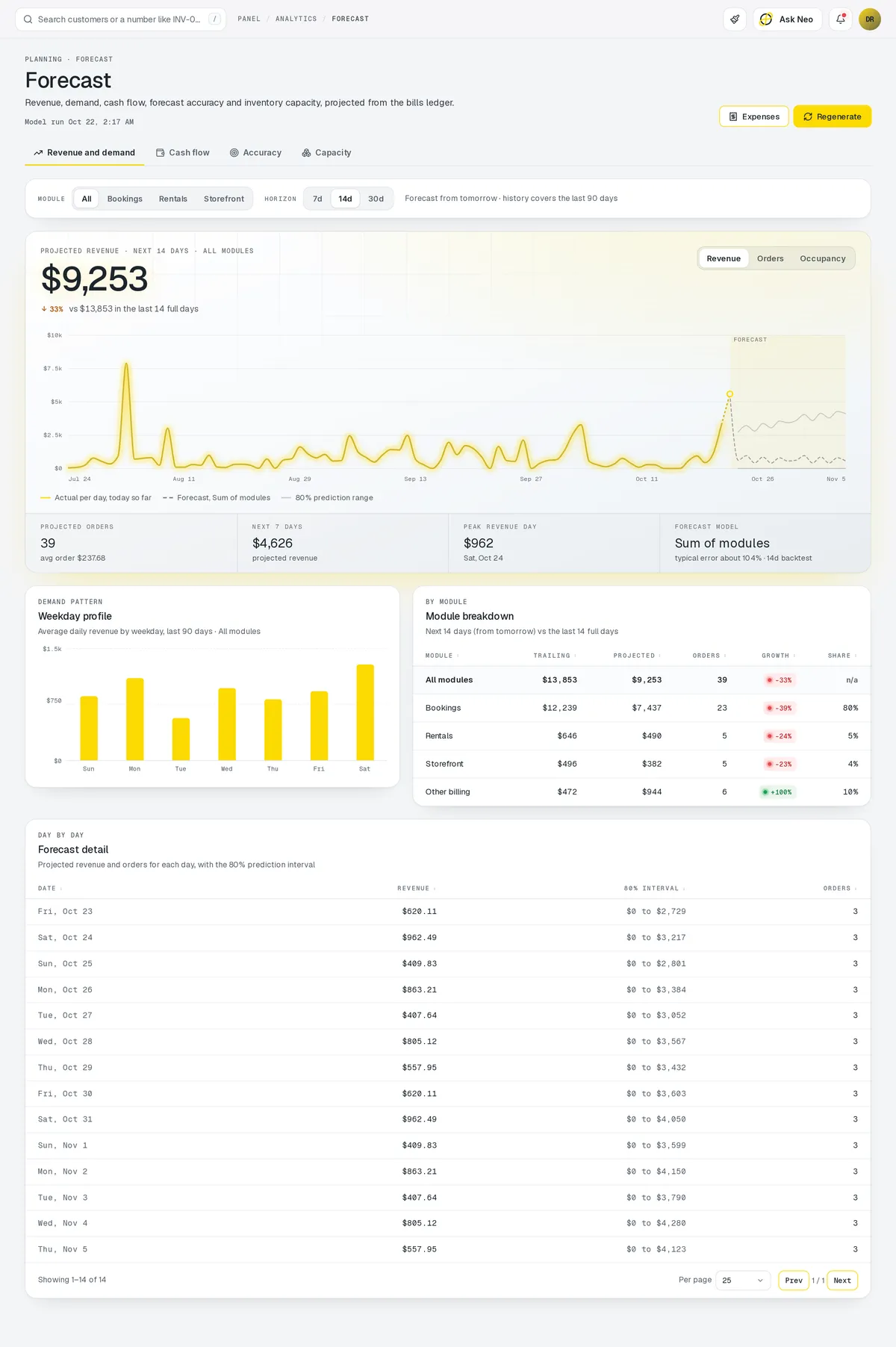
Every other module already records what happened. Forecasting is what the platform does with that history. Project demand per SKU from real sales, rental and booking records, see how many weeks of cover you have left at the current run rate, and get back the date you need to place an order rather than a number you have to interpret. Seasonality windows and supplier lead times are yours to set, and the projection re-runs itself as the underlying records change, so there is nothing to rebuild and no spreadsheet pointed at last month's export.
The history Neon is already keeping and the parameters you set go into the model, and an estimate comes out, drawn week by week over your outlook horizon.
Tent, 20×40 · $ / day
Estimate $395/day · +10% on your rate
$330
$385
$440
$360 $401
12 wks agoToday+8 wks
Sample price estimates, dollars per day
Item
Your current rate
Model estimate, next 8 weeks
Tent, 20×40
$360
$395
Skid steer
$295
$285
Bounce house
$180
$200
Sample data. The model reads the history Neon is already keeping, with the season and horizon you set, and draws
its estimate forward week by week. The estimate is a suggestion: you decide what to charge.
Forecasting · 5 features
Every feature you need, all in a single system.
01
Today
ActualProjected
Demand projection per SKU
Project demand for every SKU from your real sales, rental and booking records.
02
Weeks of cover
6.2
Order by Mar 14
Nowwk 2wk 4wk 6wk 8wk 10
Weeks-of-cover & reorder dates
Get the date you need to place an order, not a number to interpret.
03
PeakPeak
Flat averageAdjustedYour windows
Seasonality & trend adjustment
Set your own seasonality windows and the projection re-runs as your records change.
04
Suggested rate
$42/day
+$4 vs today
$30Today $38$55
SeasonUtilisationHistory
Suggested rates from season & utilisation
Get rate suggestions based on season and utilisation for the lines you choose.
05
Last 90 days
$52k
Next 90 days
$61k
RentalsSalesBookings
Revenue outlook by module
See where revenue is heading in each module, with no spreadsheet to rebuild.
What makes Forecasting in Neon fit your business?
All of it is configured from the admin panel. No developer, no plugin, no second tool.